


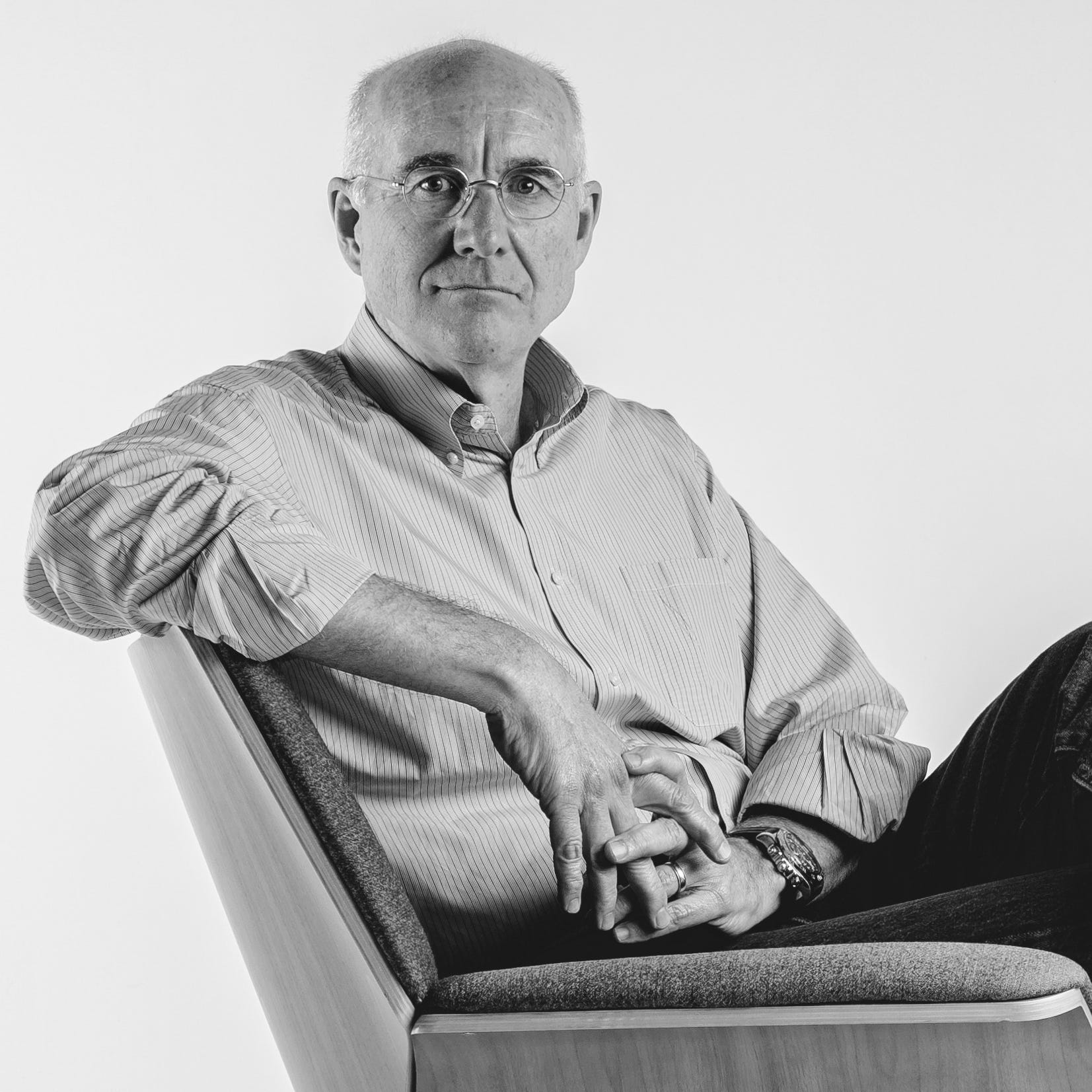
Phil Gilbert on leading IBM’s 21st century design transformation
Phil Gilbert is the author of Irresistible Change: A Blueprint for Earning Buy-In and Breakout Success.

Phil Gilbert is best known for leading IBM’s 21st century transformation as their General Manager of Design. After selling his third startup to IBM in 2010, Phil was asked by IBM in 2012 to use design thinking, coupled with agile, to update how IBM’s teams worked.
The transformation became the subject of a Harvard Business School case study, the documentary film The Loop, and feature articles in the New York Times and Fortune Magazine.
Phil’s 45-year career spans startups, large corporations, and board memberships, where he has led organizations ranging from solo ventures to those with 400,000 employees.
Phil retired from full-time operational responsibilities at IBM in 2022 in order to focus on helping the next generation of entrepreneurs, business, and military leaders understand how to impact culture at scale, to improve innovation and team performance.
Welcome to The X-Mentor, Phil!
Phil: Thank you, Greg. It’s great to see you again and good to be here.
The Diagnosis of IBM
The X-Mentor: You’ve been off the radar since leaving IBM, and I’ve wondered what you were up to. Then, your new book Irresistible Change drops. What a story. I’m thrilled you’re sharing it with the world and can’t wait for people to read it.
Let’s start at the beginning. Before you launched this initiative at IBM in 2012, was there a clear diagnosis of a problem? Did Ginni (Ginni Rometty, Former Chairman and CEO of IBM) identify the need for change, or was it something you brought to her attention?
How did it all begin?
Phil: That’s a great question, Greg. It was kind of a two-step process. When I first came to IBM in 2010, it was because the company that I was president of got acquired, a company called Lombardi Software in Austin, Texas. And IBM doesn’t “lock executives up” of the acquired companies, but I had made kind of a mental and moral commitment to my team that I would stay with them for the first year to get everything integrated properly.
I had no intention of working at a company the size of IBM. None. I just sold my third startup and figured startup #4 was out there somewhere. But shortly after I got to IBM, I couldn’t take it. So, after only 3 months in, I met with my team and I asked, “How fast can we get through the integration from a technical perspective?” And they said, it’s probably not going to take a year. We think we can do it in another three or four months. And I said, “Great, let’s do that.”
I flew to Armonk (IBM Global HQ), and I had dinner with a senior vice president named Robert LeBlanc. This was in 2010. And I told Robert, “I look around, I see people that I don’t see myself as. I see processes that seem to be stifling creativity. If it’s working for you guys, great, but it ain’t working for me. I’m out. And I’m going to stay for another three months.” We’ll get through the integration, which is called Blue Wash.
Robert said, we know we need to change, but we don’t necessarily know how. So, if you think you can help us get there, what can you do to help? That was a really interesting kind of provocation. He ended up asking me if I would run the entire business unit that had bought Lombardi, which was about 1,200 people. Lombardi had about 250. And he said, “Whatever you did at Lombardi, make that group look more like Lombardi and less like IBM.”
That went successfully.
So, when you asked if there was a diagnosis, the answer was no.
The company realized it had missed some significant trends in the marketplace. It had missed the cloud. It had missed SaaS. And I think the senior leadership knew something was wrong. But again, I don’t think they necessarily diagnosed it. And they certainly did not diagnose it as we need human-centered design, we need empathy. They certainly didn’t go that far.
So that’s how it started.
“We’ve got a problem. Our customers don’t like our products. They find it very hard to do business with us. And we’re missing significant trends in the market.
What are you going to do, team?” – Ginni Rometty
Then about 18 months later, Ginni Rometty became CEO of IBM. And at her first meeting with her senior leadership team, which included Robert LeBlanc, Ginni said, “We’ve got a problem. Our customers don’t like our products. They find it very hard to do business with us. And we’re missing significant trends in the market. What are you going to do, team?”
Robert held up his hand and said, “I know this guy in Austin, Texas. and maybe he can help.”
I met with Ginni to report progress made over 18 months on that 1,200-person unit:
· We reduced our very complex product portfolio from 44 products to 4 products.
· Our customer satisfaction was up.
· Our market share was up.
· Our revenues were up way faster than the market was growing.
· Our costs went down by about a third.
So that’s the story that I told Ginni. I didn’t really talk about design and design thinking and these inputs.
I just talked about the outcomes.
Ginni said, “Whatever you did there, can we do it everywhere?”
I said, “I have no idea. Let’s give it a go.”
Because that was an exciting problem for me.
The “Oh Shit” Moment
The X-Mentor: That’s certainly exciting, Phil.
So, no diagnosis. But IBM was clearly aware there was a problem.
In prior X-Interviews, I’ve talked about Good Strategy/Bad Strategy, a book from Richard P. Rumelt, where he outlines the kernel of a “Good Strategy.” It always starts with a diagnosis, then followed by a guiding policy, and coherent action. That’s why I was asking if IBM had diagnosed the problem to be solved.
In your book, you describe what you call your “oh shit moment” when you got the green light from Ginni and Robert. You were reflecting on a George Harrison lyric that kept running through your mind, “It’s gonna take a lot of money, a whole lot of spending money to do it right.” And you were talking about “the dog who caught the bus.”
Tell us about that “oh shit” moment, and what it really means for the dog to catch the bus.
Phil: Well, when Ginni said, whatever you did there, can we do it everywhere? And I said, I don’t know, let’s give it a go. And I still thought, look, this is IBM. At the time, there were roughly 400,000 employees. We did business in 180 countries.
In my head, I was like, okay, I’ll put something together, but this is not going to go anywhere. Because I knew the radical changes that would be needed. It went way beyond just adding designers. But that was a start.
The first thing I wanted to do is to stress test it. I wasn’t going to go spend a ton of time putting together a big, long business case and, presentations if the company wasn’t even willing to ante up the starting point. So, in a matter of a few days, I did a back of the envelope plan.
I had a fellow that I had met named Charlie Hill. And Charlie was a longtime IBMer and was also a fantastic designer and a distinguished engineer. So, he had an in with the engineering community. Charlie and I did rough calculations of just the product group. We had about 20,000 engineers. What would it take to make a dent in just the product group with designers?
I had some ratios from the work I had done in the past, roughly 1 designer for every eight coding developer was the number I used. And about half of the engineers were coders and half were not. Okay, we’ve got about 10,000 people. It’s going to take 1,000 designers. And that’s what I needed to get Ginni and Robert to understand, at least at that level, what the scope of the cost was going to be.
I wrote off an email to Ginni and Robert and I said, “I’m in, I’ll do all the detailed work, but at a high level, we’re going to have to hire 1,000 people, 1,000 new people.” This isn’t just reassigning, because the typical transformation is, oh, I’m going to reassign existing people into new roles. which they may or may not be qualified for. And I said, no, “that’s not what this is going to be. This must be net new people because we don’t have these skills at IBM. And it’s going to be 1,000. And we can’t hire them all at once, but let’s say over five years.”
That’s a big number, even for IBM. I sent the email off thinking that it was about the end of that conversation. And within a week or 10 days, Ginni writes back,
“Okay, let’s go. How fast can you go?”
That was the oh shit moment.
I was like, are you kidding me? Like, now what do I do? I mean, I’ve got no idea. I’ll be honest. I’d never worked at that scale before. I felt confident I could do it, but I didn’t know how. I didn’t know how you would get 400,000 people to do anything any one person wanted, other than maybe the CEO, because that’s where they ultimately all report up through. But here’s just this person out in Austin, Texas that has an idea, and a little bitty tiny proof point. It was 1,200 people, which is big for a lot, but it’s small for IBM. And so that was really the moment that I was like, oh gosh, I’m like that dog that’s been chasing the bus for a long time and now I’ve caught it. Now what do I do?
The Money
The X-Mentor: For our readers, that’s what “the dog catching the bus (or car)” means; when we finally reach a long-pursued goal and realize we’re not sure what comes next.
At The X-Mentor, we focus on how design drives business impact. How every human experience sparks emotion, shapes perception, and drives action. Yet many executives still view design as lacking a clear, strategic plan to create measurable value. Designers often ask for a “seat at the table” but too rarely arrive with a plan that connects design to customer needs and speaks in the language of business.
When you presented your plan and gained Ginni’s approval, what were the ROI expectations?
What was the total investment and the total return?
And as you described in your book, how did you “put the money on the screen”?
Phil: There is a lot to unpack there. But we very much used design to design the program.
When I started thinking about that problem that I just articulated, which was, okay, I’ve been asked to do this across 400,000 people, none of whom report to me. When I was put in charge of that 1,200-person unit, I was in charge, and I could make decisions and people would follow them. This was a very different problem from that. None of these 400,000 people reported to me.
The question that I had to first answer once Ginni and Robert came back and said, okay, you got your approval for the 1,000 new hires. I had to really struggle with the question of how do I do this?
“How do I get hundreds of thousands of people, hell, even 1,000 people, do something that their direct line leadership may or may not be on board with?”
How do I get hundreds of thousands of people, hell, even 1,000 people, do something that their direct line leadership may or may not be on board with? They certainly don’t want to necessarily disrupt their workflows.
When you do any change effort, when you do any transformation, it’s very funny. Human nature is such that everybody in the organization recognized change was required, but none of them thought they needed to change.
E.g., “My group is doing fine. It’s all y’all that are screwed up.”
It hit me as I was thinking through that. This was no different from every startup that I had been involved with, which is you’ve got a product, you’re a small company, nobody knows you exist. Your product has to be so good that people want it. They clamor for it. They break rules in order to install it. They get procurement to buy something from a brand new, untrusted, small vendor, which no big company wants to do. That was the same problem that I now faced, which is I’ve got to get people to want my changes so much that they will change.
I had a product to sell. And that reframed everything.
And that’s really the jumping off point for the book, which is this revelation that change, whatever the change is, in our case, it was design and design thinking. But whatever the change is, a product, the business, the enterprise, the organization are the marketplace.
Because I was so focused on outcomes—and this ties directly to ROI—I realized that while individuals influence results, it’s teams that actually deliver outcomes.
And so, teams became my customers. And from that, everything followed.
We designed a program, we branded the program the “Hallmark” program, we made the program something that people emotionally got attached to and chose to buy.
On the ROI question, we did two things.
The first principle I set for the program was that we wouldn’t measure market outcomes for three years. One of the biggest reasons transformation efforts fails is that executives try to apply ROI metrics too early. You simply can’t change an organization overnight. Real impact takes time, time to align everything from product and marketing to legal and sales so that market results truly reflect the transformation. From the start, we agreed that for three years we wouldn’t judge success by revenue. Instead, we developed in-process metrics to track growing influence, relevance, and business value. We also trusted our general managers, the ones who control resources at the team level, to continue investing only if they saw real impact. That trust was foundational.
The second principle was that the company’s only major investment would be in the first year. After that, teams would pay to participate in the program. It was a bold idea, asking people to pay to be changed, but it was intentional. I viewed the program as a product: if people don’t see value in it, we should scuttle this program. Free doesn’t drive commitment. When something is free, it becomes a checkbox exercise. E.g., People show up, comply, and move on. But when they invest in it, they engage with purpose. So, in year one, we fully funded the first seven teams and used them as proof points. From year two on, every team that joined paid to participate. That’s when real ownership and transformation began.
The X-Mentor: Other parts of the organization operate the same way. During my time at Apptio, which IBM acquired in 2023, for example, IT services were funded by the business units that used them. There’s clear precedent for this model of BUs paying for a service they value. No?
Phil: Usually not. Most programs are mandated. For example, when a CIO selects a tool like Slack, the business units pay for it, but it’s essentially a tax, meaning they don’t have a choice. Our approach was completely different. Participation in our program was entirely voluntary. Ginni never once mandated it.
We treated the program like a product. I even had a business development lead, essentially a salesperson, who promoted it across IBM by sharing success stories from teams that had already participated. Those stories became our best sales tool. Within six to eight months, demand had grown to 75 teams, even though our capacity for year two was just 25 teams.
The Guiding Policy
The X-Mentor: Phil, how much of that tied back to Ginni’s original diagnosis, when she identified the problems and asked, “What are you going to do about it?”
You said: “Ginni never once mandated it.”
Where’s the guiding policy from the C-Suite that specifies the approach to dealing with the obstacles called out in the diagnosis?
How did that cascade down to the team-level?
Clearly, you and your teams were carrying out your principles and taking coherent actions.
Phil: Yes, absolutely. As we progressed, those early, high-level observations evolved into specific, measurable goals. One of the first goals was to improve employee engagement. When Ginni became CEO, it was at a low point. We made employee engagement a key metric, tracking engagement among teams that went through our Hallmark program. The results were striking. Hallmark teams showed dramatically higher engagement scores than those outside the program.
We also began using NPS to gauge how customers felt about our products, addressing one of the initial diagnostics around customer satisfaction. And we developed metrics to track ease of doing business with IBM, which are often related to legal, finance, contracts, and sales processes. Over time, these measures gave us a far more rigorous view of how transformation was taking hold across the organization.
The X-Mentor Note: NPS does not measure “how customers feel.” It’s a survey-dependent (I.e., lagging) proxy metric that measures the likelihood of someone arbitrarily recommending a product to other customers. It does not measure actual recommendations, nor does it measure customer satisfaction. Rather, it’s a corollary metric to customer loyalty.
The X-Mentor: You and I talked earlier about the four frictions that work against change, as outlined in The Human Element by professors David Schonthal and Loran Nordgren at Northwestern University’s Kellogg School of Management.
Those four frictions—inertia, effort, emotion, and reactance—were all evident when I joined IBM in 2018. The tension among long-tenured employees was palpable: fiefdoms, territorial behavior, and resistance to change ran deep. Many questioned the effort required to shift from business as usual to a Cloud, Data & AI business. Emotion also played a role. Change felt threatening to those who had built their “home” within IBM and they very much wanted to preserve it. And when Cloud, Data & AI leaders tried to mandate transformation, it triggered reactance. I.e., the instinct to push back and protect existing structures, teams, and jobs. Things got messy, fast.
My Question: Thinking about scaling cultural change without any mandates from the CEO. Of those four frictions, which was the toughest for The Hallmark Program to overcome?
Phil: Probably, inertia.
I mean, it’s a lot of people in a lot of places. We really spent a lot of time in the first two years of really intentionally selecting which teams we worked with. And again, I think this is a mistake of most virtually all transformation efforts is they start with either a tiger team, which is some ad hoc team, or they create some innovation lab on the West Coast that has exposed brick, you know, walls and it’s cool. And they come up with ideas, and they all failed because the people in the mainstream business don’t see it as being possible to do in the everyday work environment.
Overcoming the inertia, both business and the organization that’s built to maintain the status quo, that’s the only way to scale.
Having systems and processes that maintain the status quo is not bad until the moment that it is bad, because it requires consistency of application in order to scale something. So, these processes aren’t inherently bad. They’re only bad once what you’re scaling is no longer relevant. And then you must change what you’re scaling. And that’s when you have to have the intervention with your people, their practices, and the places that they work in.
But we were very intentional about those teams, and we started to think about, one of the other things that I think is a problem is people misconstrue what a win is. We’ve all read John Kotter’s book, Leading Change. Fantastic book, that sets the strategy. It’s an awesome book. The problem is it stops short of implementation.
Kotter talks about generating quick wins. And most transformation efforts think a win is the team’s outcome in the market. And that’s certainly a part of the win, but that doesn’t necessarily prove anything about the scalability of your change program inside the organization. And so we redefined what a win was in the context of our Hallmark change program. And as we understood that better, we understood that the win had to do a couple of things.
The team’s outcome had to have a differentiated outcome than they would have had without the changes.
It also had to be a team in the business that had certain characteristics.
We needed a breadth of coverage across the business. It couldn’t just be products. It couldn’t just be software. It couldn’t just be hardware. It had to be HR and sales and finance and legal. So, we had to get a breadth of teams. The teams themselves had to have different attributes. Some of them had to be working on a first of a kind version of one thing. Some of them had to be working on what I called “the version 20” thing, an existing team that had decades of inertia behind it. We had to see how our program worked with them. So, dealing with inertia, understanding what it took to prove that we could overcome the inertia of the organization became a very critical design point of the early team selection.
The X-Mentor: I was thinking about this morning’s announcement of the Nobel Prize in Economics. The winners focused on innovation-driven economic growth, which I think might be right at the heart of what we’re seeing and discussing with technology and AI.
The winners, Joel Mokyr, Philippe Aghion and Peter Howitt, emphasized that “creative destruction” must be managed constructively, or innovation will be blocked by established companies and interest groups protecting their position.
In other words, people across the organization, whether focused on short or long-term goals, need to see that transformation aligns with their work, not that it makes them irrelevant.
What’s your thoughts on this point of view, Phil?
Phil: That was a core design principle of the Hallmark program. Having spent most of my career in B2B, I’ve learned that while your product may solve a business problem, adoption is far harder if it doesn’t also deliver personal value to the individual user. The same holds true for change, it must be meaningful at a personal level.
From the start, we made a commitment to every team: participation was voluntary, and the program had to create real value for them. If it didn’t, they could walk away, and they’d never hear from us again.
Early on, each team went through a one-week onboarding bootcamp. Everyone participated, sometimes the entire team, sometimes a representative group for larger teams. I would tell them on Monday: “If by Friday you haven’t made more progress on your product than you would have otherwise, you should leave.”
Our training wasn’t generic; it was entirely bespoke built around their product, their context, and their team. That level of relevance, combined with the freedom to opt in, created ownership. By the end of the week, every single team chose to stay.
The Divine of Design Thinking
The X-Mentor: You mentioned getting teams to Friday and showing real results through a “one-week onboarding bootcamp.” I know you’re referring to what ultimately became known as IBM Enterprise Design Thinking. However, for our readers, many still see design thinking as a workshop. E.g., “If it’s not a workshop, what is design thinking?”
Jakob Nielsen, who has also made an appearance on The X-Mentor, recently said in a LinkedIn post, “We need to stop design thinking and start design doing.” I even asked Jakob whether that contradicts Don Norman’s view that design thinking begins with deeply understanding the problem before exploring solutions. However, no response from Jakob yet.
So, let me ask you, Phil: Do we need to “stop design thinking and start design doing?”
And is design thinking still relevant in the age of AI? If so, why?
Phil:
Design Thinking is more relevant than ever because we continue to lose sight of the end user. We continue to lead with a tech first agenda. And that’s always a recipe for failure.
Design Thinking is more relevant than ever because we continue to lose sight of the end user. We continue to lead with a tech first agenda. And that’s always a recipe for failure. In fact, study after study is now showing that 95% of AI transformations are failures. Why? Because we’re too focused on the tech and not enough on the people.
Humans are funny. We get these words in our heads and then all of a sudden they get turned into these almost religious or ideologue debates. Is design thinking good? Is design thinking bad, what is design thinking?
For me, let me tell you how I came to design thinking and why it was important to me. When I first stumbled across it in the early, what became known as design thinking in the early 1990s, I’d met a couple of designers, including David Kelly, co-founder of IDEO, father of design thinking. And they were bringing the designer’s mindset, which you just described, into solving hard problems.
At that time, I was both struggling with how to scale my startup, and I was also going through personal life experiences. And I came across this thing that said, “Look at everything as something that can be improved. Find out how to better align it with the needs of your users and then change it.”
“Everything’s a prototype.” I came up with this phrase that everybody that’s ever been around me knows. I use this term every day.
For me, a lot of people go to church for that or to some place of worship. I go to design thinking for that, which is just this freedom every morning to change. And a mindset that if I want to change, I have to understand how I am relating to the people that I’m wanting to change for or with or through or whatever it might be.
That’s all Design Thinking is to me. It’s not an empathy map. It’s not a journey map. It’s absolutely not a workshop. It’s a way to approach and a freedom to approach change with new and diverse solutions every day of my life. And that’s what we tried to impart on our teams.
Now, do we also surround that with specific practices, empathy maps, journey maps, and things like that? Yes, but I think one of the differences in how we rolled out our approach to problem solving, which we called Enterprise Design Thinking. How we approached it was very team by team and very bespoke. I was much more interested in communicating with the mindset than I was in communicating the specific practices that you had to do to be a design thinker.
To everyone who gets caught up debating what design thinking really is—the same goes for agile or lean startup—once you turn any of these methods into a checklist of what’s “right” or “wrong,” you’ve already lost the plot.
The X-Mentor: Fred Reichheld, creator of Net Promotor and New York Times bestselling author of Winning On Purpose, writes about companies winning by living the Golden Rule, E.g., building cultures grounded in purpose, not just profit. In an age where AI and technology can both empower and endanger humanity, if you were giving a sermon to today’s business leaders, what would your message be?
Phil: Oh, Wow! I’m not sure exactly what the sermon would sound like, but I’m an optimist at heart. I believe AI is just a tool, one that, like many before it, is being mismanaged and underutilized. My message would be simple: get back to your people, your teams, and your customers. Focus on the real problems you’re solving, then decide where and how AI can truly help.
Too many leaders are chasing meaningless metrics. I recently read a founder bragging about firing two people and shipping 50% more code. But what does that even mean? With AI, you could ship a million percent more code. So what? These metrics are hollow. What matters is whether your products are improving, your users are more satisfied, your revenue is growing, and your employees are more engaged. If engagement is falling, you’re building a long-term problem.
“Companies must refocus on the humans they serve and the humans they employ, that’s what drives market cap over time, not how much code is generated by AI.”
Companies must refocus on the humans they serve and the humans they employ, that’s what drives market cap over time, not how much code is generated by AI. Right now, too many organizations are letting technology lead them, rather than leading with intent.
We’ve seen this pattern before. During the internet era, it wasn’t until Jeff Bezos reframed everything—treating all work as a service and every stakeholder as a customer—that real value emerged. The same will happen with AI.
The question isn’t whether AI will change your business, it will. The question is how intentionally you’ll use it to create competitive advantage.
Not through cost-cutting or vanity metrics, but by delivering greater value to customers.
The leaders who do that first will win.
The X-Mentor: Phil, I’d love to keep this conversation going, but we’re getting close to time to wrap up. So, one last question regarding managing experiences like a business.
At The X-Mentor, we’ve published a lot on this idea of shifting from product experiences to the journey, E.g., Nielsen Norman Group’s Senior User Experience Specialist, Kim Flaherty on Customer Journey Management and how CX and UX are converging with journeys being that unit of change.
We’re seeing a shift from isolated product experiences to connected customer journeys, where the goal is to measure the real-time heartbeat of customer engagement rather than relying on high-level, lagging metrics like NPS, CSAT and CES. And digital-dominant businesses such as Amazon have enough of a cardiovascular system, digitally speaking, that you could actually see all this happening in real-time across billions of journeys.
The question: As companies shift from focusing on products to managing end-to-end customer journeys, how can organizations move beyond lagging metrics like NPS (I.e., to inspired Irresistible Change) so that they can measure the real heartbeat of the customer experience in real time?
Phil: The first time in a long time anybody’s referred to Amazon as having a heart.
[Laughter Erupts]
The X-Mentor: Jeez, Phil. I’m not talking literally. Of course, Amazon doesn’t have a heart. 😉
I mean the organization’s digital cardiovascular system that connects all the customer journeys. For example, the Six (6) Universal Experiences you describe in your book are real, but they shouldn’t be confused with the journeys themselves. Right?
Today, we can see more clearly what customers are trying to achieve in real time. Their journeys aren’t linear; people move in and out of them constantly. But each journey represents a goal they’re trying to reach. E.g., Replenish laundry detergent, buy Phil’s book, watch a movie, compare Rx to OTC drugs, buy a car, shop auto insurance, etc.
If we understand their context and the obstacles in their way, we can help them succeed faster. When customers achieve their goals faster and more completely, they realize the value of getting that job done with ease. That experience is not something a company delivers. Rather, that’s something that happens in the heads of customers, and that’s what ultimately drives value back to the business. It’s “value to the customer first” that fuels business performance, not the other way around. Or as I like to say: “Rock, then roll—always in that order.”
Phil, what you’ve done in your new book, Irresistible Change, brilliantly connects these dots, and I can’t wait to see it make the impact it deserves.
Phil: Thank you, Greg. It’s available now for pre-order as we record this and it drops on November 12th, 2025. So, it’s available where all books and e-books are sold.
You know, when I set out to write it, I talked about John Cotter’s book before. John Cotter’s book, Leading Change, has had a tremendous influence on my life, business life, ever since it was released in 1996.
As I mentioned earlier, I saw many people misapplying those strategies. My goal was to write the operating manual for Kotter’s Leading Change. If you put the two side by side, you’ll gain complementary perspectives on how to lead large-scale transformation, and make it stick.
The X-Mentor: Phil Gilbert, thank you for being part of The X-Mentor. Your insights were invaluable, and it was a genuine pleasure speaking with you.
Phil: Greg, great to see you again. I’ve had a ball.
ABOUT THE AUTHOR(S)
Phil Gilbert is the author of Irresistible Change: A Blueprint for Earning Buy-In and Breakout Success and is best known for leading IBM’s 21st century transformation as their General Manager of Design.
Greg Parrott is The X-Mentor and publisher of The X-Mentor on Substack.
Great interview. Looking forward to read Phil’s book